


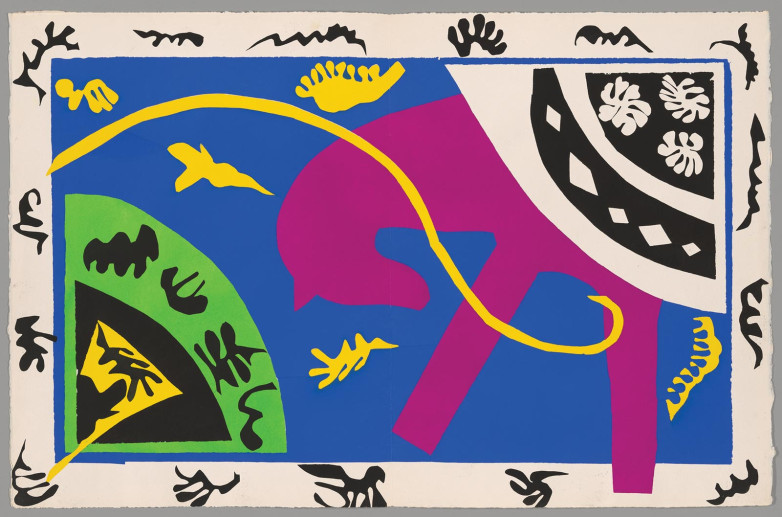
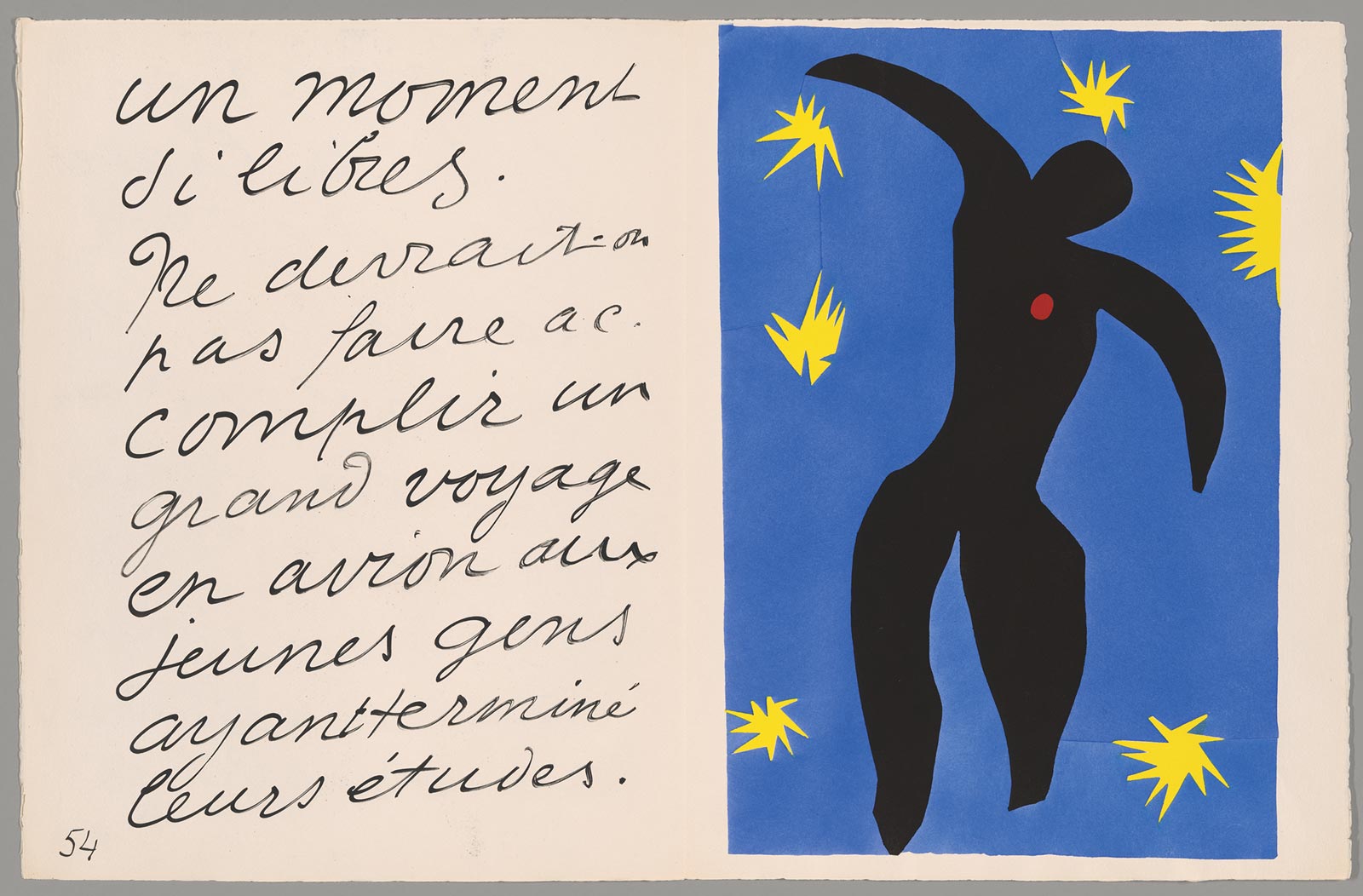
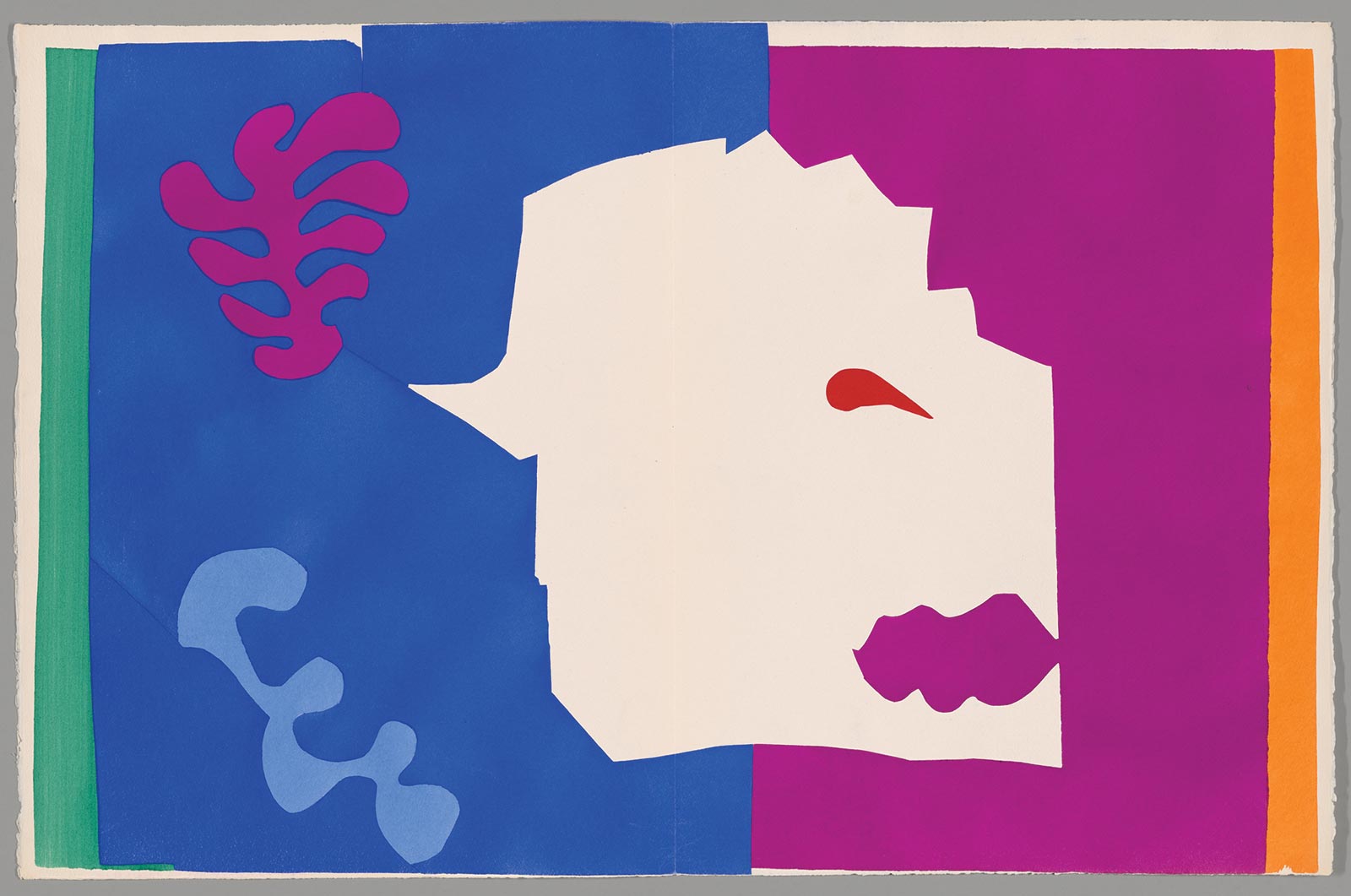
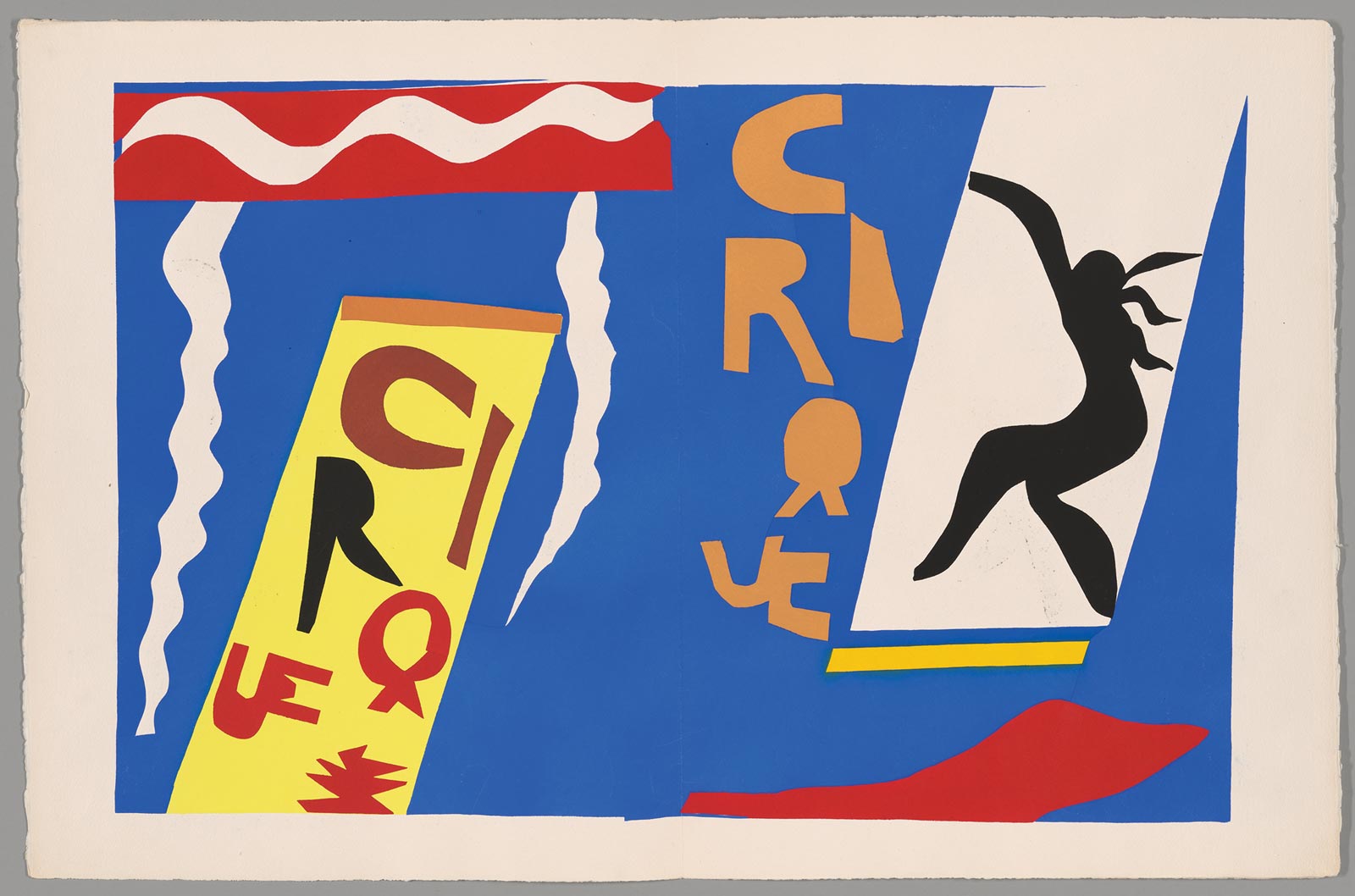
Matisse embarked on a series, three of which were initially printed as covers for Verve, an art magazine published by his friend and collaborator, the Greek writer Tériade. But both men envisioned more, and the final product was twenty pochoir print plates. With accompanying text by Matisse, the plates were assembled into an unbound book entitled Jazz, completed in 1944 and published in 1947. Its subject matter ranges from circus performers and music hall scenes to more political imagery, like a red-eyed wolf that evokes the menace of fascism.
Although Matisse and Tériade collaborated both before and after Jazz, it is singular in that the words and images are all from Matisse’s hand. “Jazz is Matisse at his most personal and vulnerable. Both the images and the text convey an intimate side of Matisse, one that he usually kept safeguarded from the public,” said Emily Ziemba, director of curatorial administration and research curator for prints and drawings at AIC. “Jazz endures because it is multilayered. With symbols of war and loss, it can be read as a book of quiet resistance,” observed Ziemba, “but with the vivid colors and the seemingly happy scenes they depict, Jazz illustrates our universal need to reach for happiness during times of uncertainty, anxiety, or chaos.”
Before his surgeries, Matisse asked his doctors, “Give me three or four more years to finish my work,” not knowing that he would have to reimagine how he worked. After completing the plates for Jazz, he pushed his cut-paper compositions to larger and larger scales, creating murals such as Oceania the Sky and Oceania the Sea (1946) and the site-specific The Swimming Pool (1952), which transformed the walls of his studio. In 1948, he began planning the Chapelle du Rosaire in Vence, France, using cut paper to design the architecture, stained-glass windows, interior murals, and more. After its completion, he continued to take commissions for stained glass, designed using his cut-paper technique. Having achieved the unification of color and line with the paper, the glass allowed the artist to infuse these final works with light, transcending opacity and allowing the viewer to become immersed in color and form.