
Erased, Burned, or Hidden from Sight, Unreadable Texts Are Being Decoded

Courtesy Cambridge University Library/Błażej Mikuła/Amélie Deblauwe

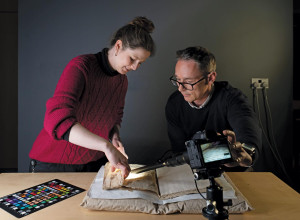
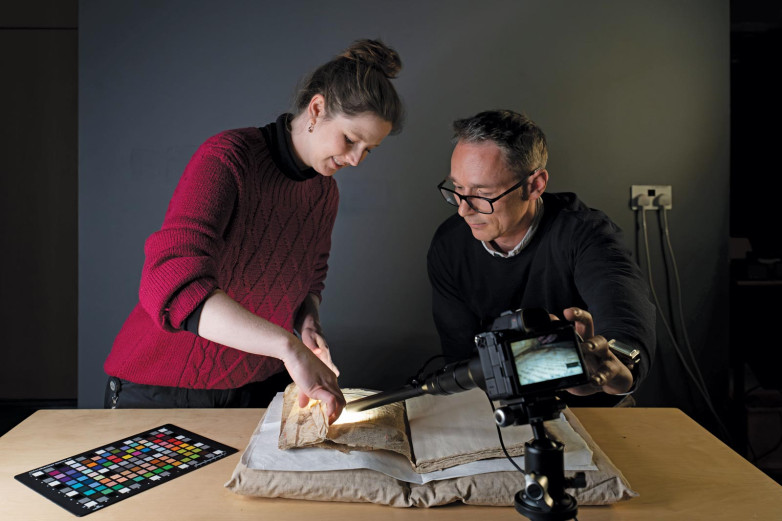
Conservator Sally Kilby and Błażej Mikuła at Cambridge University Library photographing the medieval Merlin manuscript used as the cover for a later book.

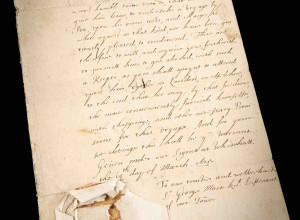
There are wizards at Cambridge University Library. They’re using multispectral imaging (MSI), CT scans, and 3D modeling to peer deep into a book at their holdings. Stitched into the binding of a sixteenth-century register is a story hidden for nearly 400 years. Using these latest technological advances, the scholars announced last year that they were able to read this lost text. It is the only surviving fragment of a medieval manuscript telling a story of King Arthur’s court and a magician named Merlin.

Elsewhere, at the British Library, the reign of Queen Elizabeth I has further been illuminated by researchers using enhanced imaging technology to read hidden passages of William Camden’s Annals, the first official account of the Queen’s time at court, published soon after her passing.

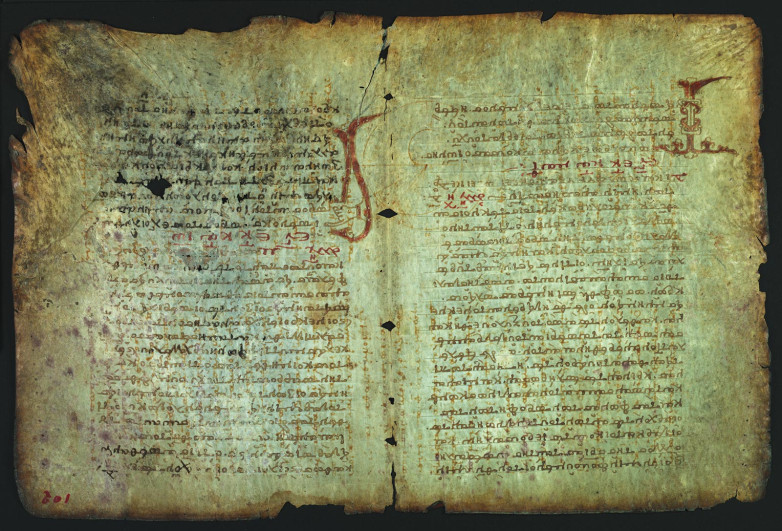
Meanwhile, scientists are hard at work on the Archimedes Palimpsest, a thirteenth-century prayer book that contains erased texts predating the religious material by centuries. What was it that was hidden? Two treatises by Archimedes, the ancient Greek thinker known as the father of static mechanics and mathematical physics. They’ve been found nowhere else. Also hidden, leaves from a commentary on a treatise by Aristotle.

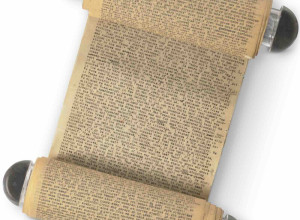
Technological advances, from imaging to artificial intelligence (AI), are giving scholars, and the world at large, greater access to groundbreaking books and history. University of Oxford researchers are revealing erased lines in Alfred Tennyson’s manuscripts; researchers at the University of Kentucky have digitally unwrapped ancient papyri from Herculaneum that were carbonized by the eruption of Mount Vesuvius in 79 CE. At Western Michigan University, researchers are scanning medieval documents to not only read them, but also to advance humanities research for future scholars. Using X-rays and 3D modeling, a thin silver plate that was rolled up and stored in an amulet from the mid-eighth century CE can be deciphered. The plate tells the story of a man arriving in the Muslim town of Jerash in Jordan. The man was a wizard.

Courtesy Cambridge University Library

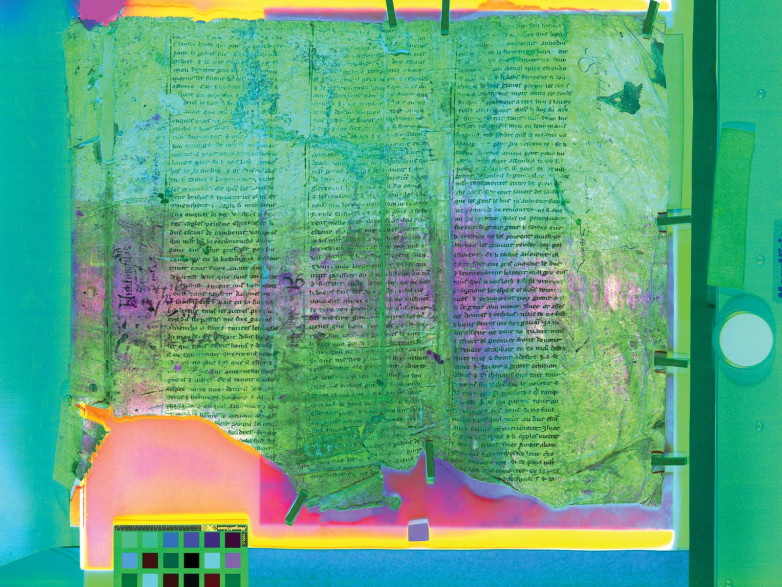
Multispectral imaging can reveal faded and erased text invisible to the naked eye, as seen with this capture of the Merlin manuscript.

Reading these ancient texts is not magic. It is science. “Whenever we see opportunities to uncover layers of history with technology, we try to reach out to the research community and build up interest to formulate and answer important questions,” said Irène Fabry-Tehranchi, French specialist at Cambridge University Library, who has been working on the Merlin manuscript.

It was 2019 when archivist Sian Collins rediscovered the fragment. A bifolium—meaning two sheets folded together to form four leaves—of the medieval French Suite Vulgate du Merlin had been reused as a cover for the court rolls of Huntingfield Manor in Suffolk. Fabry-Tehranchi recalled, “Sian read the words Excalibur and Gauvain and was thrilled about it!”

MSI can take several photographs at once, using different colors of light, including colors that we can’t see, like infrared. The MSI done on the Merlin fragment provided access to faint, erased parts and marginal annotations that were unreadable to the naked eye. Fabry-Tehranchi stated plainly, “MSI was invaluable.”
Courtesy of Roger Easton

The Archimedes Palimpsest. 

Invaluable, also, to those at the British Library, as they perused the Camden Annals. “Analyzing hidden passages alongside the visible drafts has revealed many details about Elizabethan history that were previously unknown,” said Helena Rutkowska, faculty of history at Oxford. One of the most important findings was the discovery of an earlier draft stating that Elizabeth had never named James as her successor on her deathbed. 

The Annals cover her entire reign from 1558 to 1603. It took Camden over twenty years to write. King James ordered Camden to publish the first three books in 1615, though it wasn’t until 1625 that all four volumes were finally published. 

“Camden meticulously revised the text,” Rutkowska said, “as part of his historiographical practice, which we now know thanks to the survival of the draft manuscripts.” The British Library has over 4,000 pages full of deletions, emendations, and amendments. It is all readable now, thanks to imaging advancements. Using transmitted light photography, the entirety of this work was digitized in 2023.

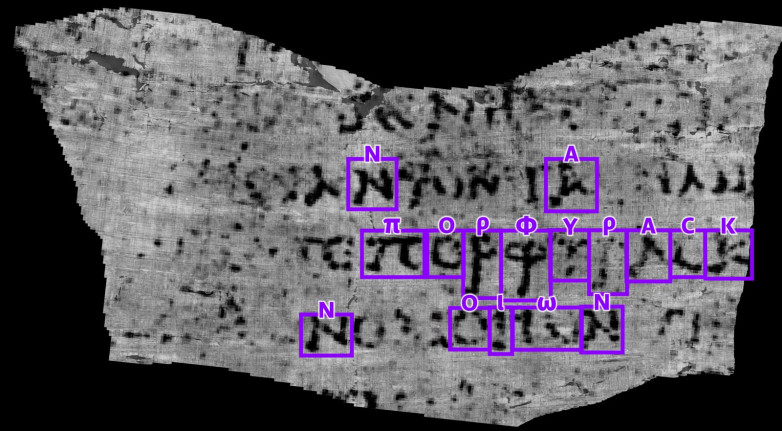
Courtesy EduceLab

Herculaneum scroll being scanned at Diamond Light Source inside its scanning case. 

Roger L. Easton, Jr., a professor at Rochester Institute of Technology, is involved in the reading of the Archimedes Palimpsest. He sees a continuum between the scribes of the past and the scientists of today. “These men were doing their utmost to ensure the preservation of the thoughts they were writing—in some ways, they were the imaging scientists of their day, working with the only imaging tools available to them.” He added, “I see us, the modern imaging scientists, as collaborating with our predecessors to ensure the preservation of those thoughts.”

Helen Davies, formerly co-director of the Center for Digital Humanities at the University of Colorado-Colorado Springs and now an assistant professor at the University of North Carolina at Charlotte, concurs. She used imaging to read medieval manuscripts and documents for staff, scientists, and students at the 2024 International Congress of Medieval Studies at Western Michigan University. She said, “One of my driving motivations in working with this technology is to help recover histories, documents, stories, and material from people or communities whose documents may not have been prioritized for preservation. … I want these stories to be read, remembered, and shared.”

No matter if the stories are erased, glued together, torn, tattered, faded, burned in a volcanic eruption, or written in silver inside an amulet, revealing them is something like magic.